Geometric Constants
This is about several constants related to the geometry of the network.
n_steps
The network views each speech sample as a sequence of time-slices \(x^{(i)}_t\) of
length \(T^{(i)}\). As the speech samples vary in length, we know that \(T^{(i)}\)
need not equal \(T^{(j)}\) for \(i \ne j\). For each batch, BRNN in TensorFlow needs
to know n_steps which is the maximum \(T^{(i)}\) for the batch.
n_input
Each of the at maximum n_steps vectors is a vector of MFCC features of a
time-slice of the speech sample. We will make the number of MFCC features
dependent upon the sample rate of the data set. Generically, if the sample rate
is 8kHz we use 13 features. If the sample rate is 16kHz we use 26 features…
We capture the dimension of these vectors, equivalently the number of MFCC
features, in the variable n_input.
n_context
As previously mentioned, the BRNN is not simply fed the MFCC features of a given
time-slice. It is fed, in addition, a context of \(C \in \{5, 7, 9\}\) frames on
either side of the frame in question. The number of frames in this context is
captured in the variable n_context.
Next we will introduce constants that specify the geometry of some of the non-recurrent layers of the network. We do this by simply specifying the number of units in each of the layers.
n_cell_dim
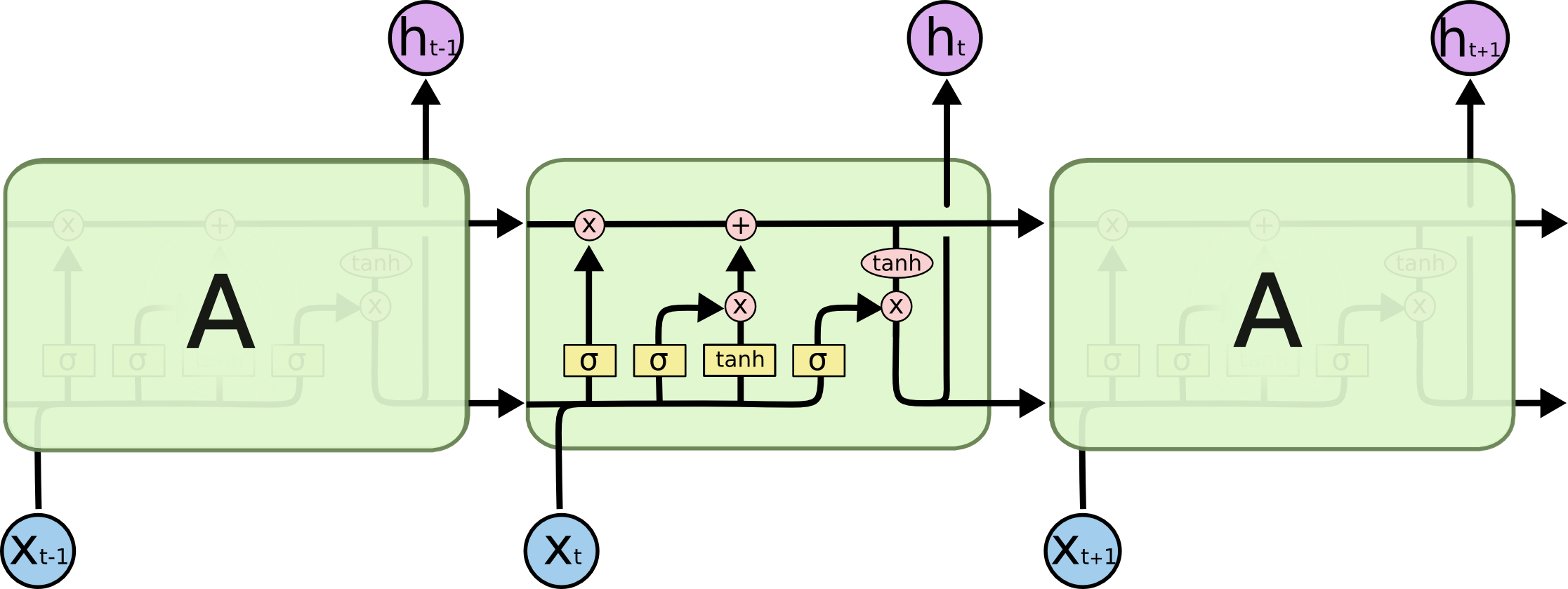
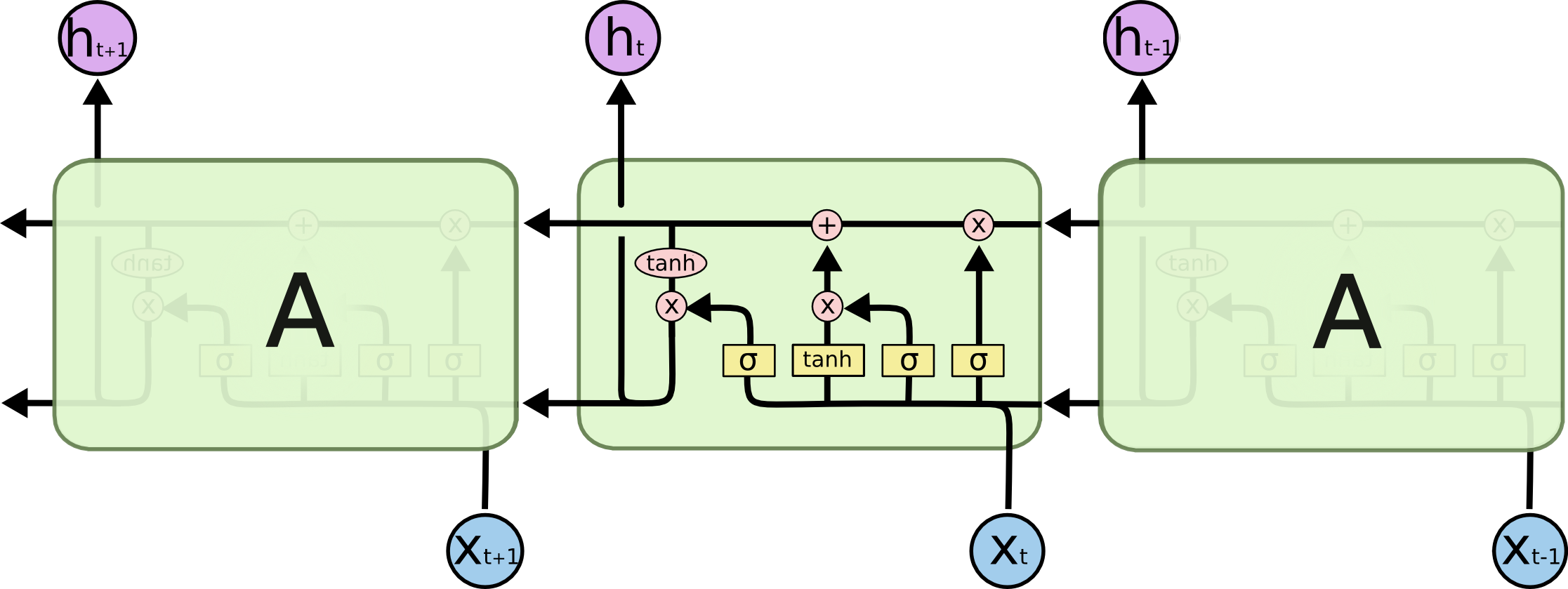
Hence, we are free to choose the dimension of this cell state independent of the
input dimension. We capture the cell state dimension in the variable n_cell_dim.
n_character
The variable n_character will hold the number of characters in the target
language plus one, for the \(blank\).
For English it is the cardinality of the set
we referred to earlier.